50 Democracy Glyph Icons: A Visual Toolkit for Civic Projects
In the world of design, especially when working on projects centered around politics, social movements, or civic engagement, the right visual language is everything. You need assets that are instantly recognizable, carry the right weight, and work seamlessly across every platform you can imagine. That's precisely the challenge the 50 Democracy Glyph Icons set was built to solve. This isn't just a random collection of symbols; it's a cohesive system designed for clarity and impact, built on a robust grid to ensure every icon feels unified and professional.
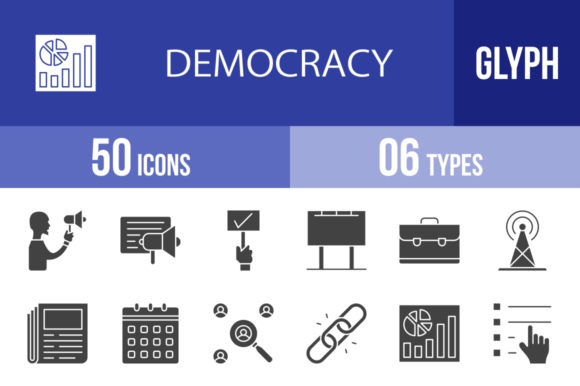
What immediately stands out about this collection is its versatility. The set includes 50 distinct icons covering a comprehensive range of democratic concepts—from the foundational ideas like Constitution and Law to the active processes of Election, Protest, and Debate. You'll find symbols for modern tools like Online Voting and Smartphone, alongside timeless representations of Freedom Of Speech, Human Rights, and Equality. Each icon is a 100% vector, meaning you can scale them to the size of a billboard or a tiny app icon without losing a pixel of sharpness. The inclusion of six formats—AI, CDR, EPS, JPG, PNG, SVG—means they're ready for any workflow, whether you're a designer using Adobe Illustrator, a developer needing scalable SVGs for a website, or a marketer pulling a quick JPG for a social post.
Where These Icons Make a Real Difference
Think beyond a simple website sidebar. The practical applications for the 50 Democracy Glyph Icons are vast. For web design and mobile app development, they are perfect for creating intuitive navigation in civic tech platforms, voting information hubs, or news sites covering political affairs. The clean, glyph-based style ensures they remain legible at small sizes, a crucial factor for UI/UX design. In editorial design and publishing, these icons can break up long-form articles on policy, visually highlight key points in a report, or add professional flair to a magazine layout about social justice.
For brand identity and logo design, the icons offer a strong starting point. A non-profit focused on voter registration could use the Vote or Ballot Box icon as a core element of their logo. A law firm specializing in civil liberties might incorporate the Supreme Court or Scales icon into their letterhead. The consistency provided by the grid system means you can use multiple icons together across a brand identity system—on a business card, a presentation template, and a website—and they will always look like they belong together. This builds recognition and a sense of professionalism.
Don't overlook the power in print design and packaging. A grassroots campaign's poster or billboard can use the Megaphone or Protest icon to convey its message instantly. A book on political history could use these icons as chapter markers. For social media graphics, they are invaluable. Create consistent, on-brand templates for Instagram stories, Twitter posts, or Facebook announcements about community meetings, rallies, or legislative updates. The PNG files with transparent backgrounds make this drag-and-drop simple.
Integrating Icons into Your Design Strategy
Using a set like the 50 Democracy Glyph Icons effectively is about more than just decoration. It's about enhancing visual hierarchy and readability. Placing a relevant icon next to a section header in a report or a key statistic in an infographic draws the eye and helps organize information. This improves the user's ability to scan and comprehend content quickly, which is critical for engagement.
When choosing which icons to use, consider your project's core message. Are you focusing on the process (like Election, Poll, Vote) or the principles (like Freedom, Equality, Rights)? Mix and match with intention. The set's variety allows you to tell a complete visual story. For a campaign about corruption, pairing the No Corruption icon with Law and Judgment creates a powerful narrative without a single word of text.
A key strength of this collection is its neutrality and clarity. The style is not overly stylized or trendy; it's functional and authoritative. This makes it a safe and effective choice for a wide range of audiences, from grassroots activists to established institutions. The vector icons are easy to edit—you can change colors to match your brand palette in seconds, ensuring perfect integration into any existing design assets.
Before finalizing your project, always test your icon usage. View them at the intended size, on the intended medium. Does the Television icon still read clearly as a small favicon? Does the Flag icon maintain its dignity when used as a background watermark? The provided formats make this testing phase effortless. Remember, the goal of using these democracy glyph icons is to clarify, not complicate. They should serve the content, making your message about civic engagement, political discourse, or social change more accessible, more professional, and ultimately, more powerful. This toolkit provides the visual vocabulary to do exactly that.